
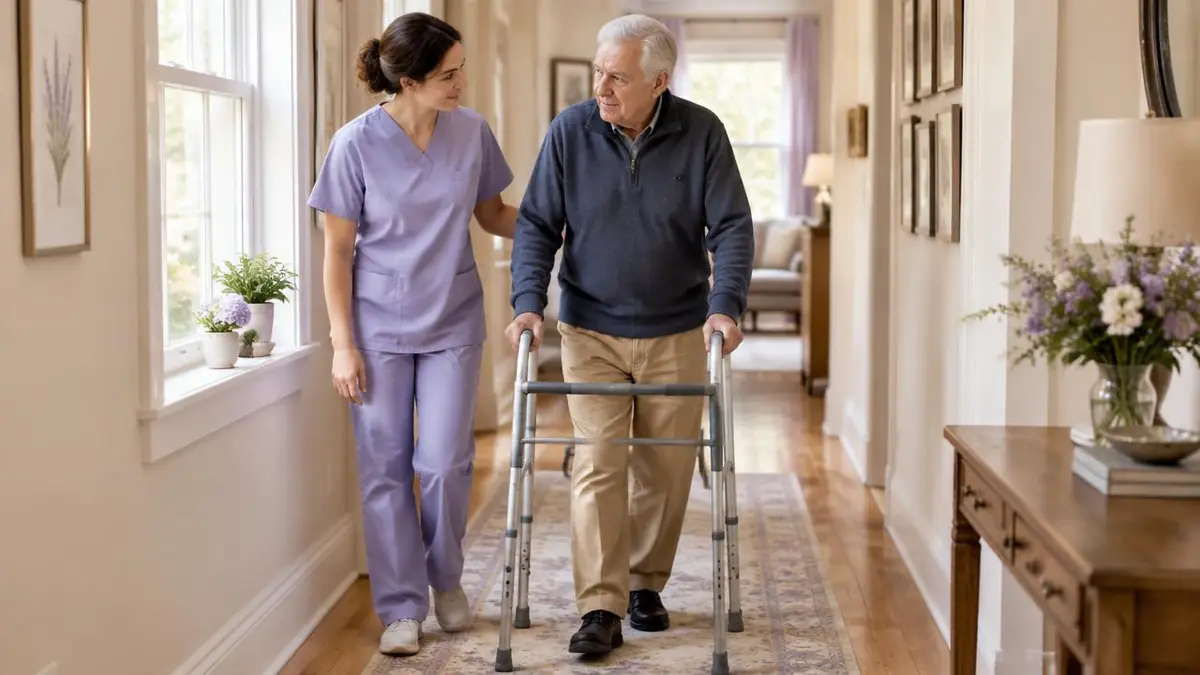
A More Advanced Approach to Parkinson's Care at Home
Powered by Angels on Call Homecare, this model goes beyond traditional support. It represents a more advanced approach to Parkinson's care at home, built on:
- Clinical oversight
- Mobility-focused Care Professional training
- Structured daily routines
- Specialized accreditation
Recognized through Certified in Parkinson's Disease Care (CPDC™) and aligned with the Parkinson's Foundation through Community Partners in Parkinson's Care (CPPC), this is care designed with intention, not improvisation.
This is not general homecare adapted to Parkinson's. This is Parkinson's care engineered for the home.
Recognized, Accredited, and Built for Specialized Parkinson's Care
Certified in Parkinson's Disease Care (CPDC™)
Advanced, accreditation-backed Parkinson's care training and standards.
Community Partners in Parkinson's Care (CPPC)
A Parkinson's Foundation Community Partner designation, aligned with the Foundation to elevate care, education, and support.
Parkinson's Clinical Leadership: Site Champions & CPDC Advocates
Dedicated internal leaders driving Parkinson's education, specialized training, and continuous care improvement.
Age-Friendly Health System
Committed to Care Excellence through the Institute for Healthcare Improvement.
Top 10% Nationwide for Client Experience
Leader in Experience, Best of Home Care recognition.
Certified in Parkinson's Disease Care (CPDC™): A National Standard, Not a Generic Promise
Angels on Call Homecare became the first homecare agency in the United States accredited in Certified in Parkinson's Disease Care (CPDC™), establishing a new benchmark for what specialized Parkinson's care at home can look like. This distinction matters because Parkinson's disease is not a simple movement disorder. It is a complex, progressive neurological condition that affects mobility, medication timing, cognition, mood, sleep, communication, and everyday function. CPDC is specialized accreditation designed for agencies that demonstrate a real commitment to high-quality, Parkinson's-specific care planning rather than routine homecare generalized to a neurological diagnosis.
CPDC is meaningful because it pushes care beyond surface-level support. It emphasizes staff education, Parkinson's-specific care planning, symptom awareness, medication timing, and therapy considerations for people living with Parkinson's disease. This shows up clearly through RN-led assessments, care plans structured around TULIPS, movement and exercise support, and documented attention to on-time medication reminders, an especially important issue in Parkinson's care, where missed or delayed doses can directly affect function and quality of life.
Angels on Call has not merely achieved the accreditation once, but has continued the work required to sustain that standard. Angels on Call Homecare has successfully completed its re-accreditation cycle in Certified in Parkinson's Disease Care (CPDC™), reinforcing its ongoing commitment to specialized Parkinson's education, standards, and accountability.
What CPDC Means
Certified in Parkinson's Disease Care (CPDC™) recognizes organizations that build care around the realities of Parkinson's disease: motor symptoms, non-motor symptoms, medication timing, therapy coordination, and person-specific care planning.
Why It Matters
For families, CPDC means greater confidence that care is being delivered by a team trained to understand Parkinson's beyond tremor alone. For organizations, it creates a framework for more consistent, more specialized, and more accountable care.
Benefits of CPDC
This accreditation supports stronger care planning, more informed medication reminders, more coordinated therapy awareness, and a clearer standard for delivering Parkinson's-specific care at home.
CPDC Advocates
CPDC Advocates help carry Parkinson's-specific knowledge into everyday practice, strengthening internal awareness, staff confidence, and consistency in how care is delivered.
Community Partners in Parkinson's Care (CPPC): Connected to the Parkinson's Foundation, Built for Better Care
Angels on Call Homecare is also a recognized Community Partner in Parkinson's Care (CPPC) through the Parkinson's Foundation, which strengthens the organization's access to professional education, caregiver resources, staff tools, ongoing communication, and condition-specific training infrastructure.
CPPC is not just a logo relationship. It includes staff education pathways, Site Champion responsibilities, practical care tools, access to the Parkinson's Foundation Learning Lab, books and fact sheets through the Foundation library, the Care Partner Program, helpline access, and marketing and membership resources. All new hires receive Parkinson's-specific education at orientation, and this training is reinforced through ongoing education informed by Angels on Call's CPPC relationship and internal Parkinson's programming.
What CPPC Is
A Parkinson's Foundation program that supports organizations in strengthening Parkinson's care through education, staff development, tools, communication, and quality improvement.
Why It Benefits Families
It means the organization has access to a broader Parkinson's knowledge base, practical resources, and structured educational support that can improve the quality and consistency of care.
Training & Education
New hires receive Parkinson's-specific education at orientation, and staff knowledge is reinforced through ongoing training, experiential tools, webinars, and updates connected to CPPC participation.
Resources We Receive
The Parkinson's Foundation provides access to the Learning Lab, books, fact sheets, caregiver tools, support group resources, the Care Partner Program, helpline support, and discipline-specific educational offerings.
Two Site Champions
Angels on Call's two Site Champions help ensure Parkinson's knowledge is translated into practice, not left sitting in training binders.
CPDC Advocates & Site Champions: Internal Leaders Driving Parkinson's Excellence
What a CPDC Advocate is
A CPDC Advocate helps strengthen Parkinson's-specific awareness and practical application inside the organization, supporting consistent care standards, reinforcing specialized knowledge, and helping keep Parkinson's care visible across teams.
Role of a CPDC Advocate
CPDC Advocates help bring accreditation standards to life by supporting education, reinforcing Parkinson's-specific care principles, and helping ensure that day-to-day care reflects specialized rather than generic practice.
What a Site Champion is
A Site Champion is a designated internal leader within the Community Partners in Parkinson's Care model who helps guide staff training, communication, resource use, and quality-related follow-through.
Role of the Site Champion
Site Champions help coordinate staff participation in Parkinson's training, outcomes tracking, medication-related audits, communication with the Parkinson's Foundation, use of TULIPS reminders, and ongoing site-level improvement work.
Their expertise
Together, CPDC Advocates and Site Champions strengthen Parkinson's care across medication timing, communication, safety, mobility cueing, transitions, family education, and condition-specific training. Training materials cover atypical Parkinsonism, care transitions, mental health and cognition, mobility and falls prevention, sleep, and integrated Parkinson's care strategy.
Ongoing site review
Through ongoing review processes, medication audits, staff education tracking, and structured Site Champion follow-up connected to the Parkinson's Foundation model, Angels on Call continuously strengthens its Parkinson's care systems.
Understanding Parkinson's Disease
Parkinson's disease is a chronic, progressive neurological condition that affects movement, timing, cognition, mood, sleep, and daily function. While many people associate Parkinson's with tremor, the condition is much broader. Core motor symptoms include tremor, rigidity, slowness of movement, and gait or balance changes. But Parkinson's also involves non-motor symptoms such as anxiety, depression, apathy, constipation, cognitive slowing, sleep disruption, hallucinations, and reduced automatic movement.
Because Parkinson's affects each person differently, good care must be individualized. Some individuals need close attention to medication timing. Others need mobility cueing, fall prevention strategies, exercise support, sleep-related support, family education, or help navigating cognitive and emotional changes. That is why generalized homecare often falls short. Parkinson's care at home must be structured around the person's symptoms, rhythms, therapies, and daily realities.
Core Motor Symptoms
- Tremor
- Bradykinesia
- Rigidity
- Posture, gait, and balance changes
Common Non-Motor Symptoms
- Mood changes
- Anxiety and depression
- Apathy
- Cognitive change
- Sleep problems
- Constipation
- Hallucinations in some individuals
Mobility & Falls
- Freezing
- Festination
- Retropulsion
- Transfer difficulty
- Falls and fear of falling
Medication Timing Matters
Parkinson's medications should be documented and taken at specific scheduled times rather than broad generic frequencies whenever possible, because timing can directly affect function. Care Professionals support this with on-time reminders in coordination with the care team.
Exercise & Therapy Matter
Exercise, rehab therapies, and movement support can play an important role from diagnosis forward, and no single protocol fits everyone.
Family Caregiving Matters
Care partners often carry major responsibility around medication schedules, falls risk, unpredictability, and long-term adjustment.