

Skip to content

    Powered by

    Angels on Call Homecare

    Call
    Back to Blog & Insights
    Dementia Care

    Dementia Hallucinations, Delusions and Paranoia: When to Reassure, and When to Call the Doctor

    Hallucinations, delusions and paranoia in Dementia explained, how they differ, what usually helps, and the warning signs that mean it's time to call the doctor.

    Eric J. Dalton, Vice President, Angels on Call Homecare

    Eric J. Dalton

    Vice President, Angels on Call Homecare

    •Aug 5, 2026• 4 min
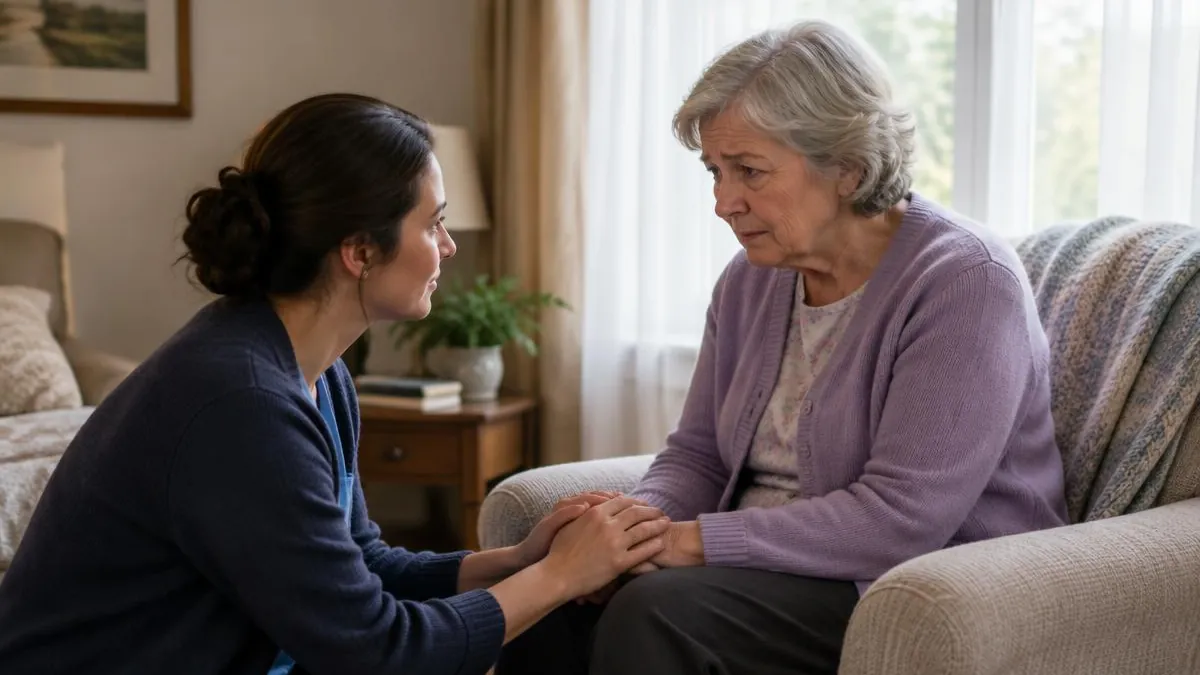
    Caregiver kneeling and calmly holding the hands of a worried older woman by a window, reassurance during Dementia hallucinations

    Hallucinations, delusions, and paranoia are common in middle- to late-stage Dementia and are usually not a psychiatric emergency on their own. Gentle reassurance, rather than correction or argument, is typically the most effective response. New, sudden, or unusually distressing episodes, especially alongside illness, warrant a medical evaluation.

    Hallucination, Delusion or Paranoia? The Key Differences

    These three words get used almost interchangeably by families, but they describe different experiences. A hallucination means seeing, hearing, smelling, tasting, or feeling something that isn't actually there, the Alzheimer's Association describes people with Alzheimer's sometimes seeing insects on their hand or hearing voices that aren't present. A delusion is different: it's a fixed false belief, not a sensory experience, believing, for example, that a family member is stealing from them. Paranoia is a specific, common type of delusion involving suspicion that others are being unfair, dishonest, or threatening.

    Knowing which one you're seeing matters less for how you respond in the moment, reassurance works for all three, and more for how you describe it to a doctor, since the pattern and content can offer real diagnostic clues.

    Why This Happens in Dementia

    These experiences stem from complex changes occurring in the brain as Dementia progresses. Memory loss plays a direct role in paranoia specifically: when a person forgets where they placed an object, “I misplaced it” isn't available to them as an explanation the way it is for someone with intact memory, so “someone took it” becomes the only story that makes sense of what they're experiencing. Understood this way, paranoia often isn't really about the accused person at all, it's the mind's attempt to explain a gap that memory loss has created.

    What Families May Notice

    Common hallucinations (seeing people, insects, movement)

    Visual hallucinations are the most frequently reported type, though hearing, smelling, or feeling things that aren't there also occur. They tend to become more common in the middle and later stages of Dementia.

    Common delusions (theft, infidelity, abandonment)

    A parent may insist a caregiver is stealing money, a spouse may believe their partner is unfaithful, or a person may become convinced they're about to be abandoned or moved somewhere against their will. These beliefs feel completely real to the person experiencing them, however implausible they sound from the outside.

    Paranoia and suspicion toward caregivers

    Because paranoia is often triggered by memory loss, it frequently lands on whoever is closest, usually the primary caregiver, which can be one of the more painful parts of the disease for a family member to absorb personally, even while understanding intellectually that it isn't really “about” them.

    What Usually Helps

    Reassurance over correction

    Rather than insisting “that's not real” or “I didn't take anything,” acknowledging the person's feeling without necessarily confirming the false content tends to de-escalate faster: “I can see that upset you, you're safe, and I'm right here.”

    Reducing environmental triggers (shadows, mirrors, noise)

    Check for sounds that could be misread (a television, an air conditioner), and look for lighting that casts shadows or reflections. Some families find covering or removing mirrors helpful if the person no longer recognizes their own reflection and reacts to it as an intruder.

    Gentle redirection

    Moving to another room, stepping outside briefly, or shifting attention to a favorite activity or photograph can interrupt a hallucination or delusion more effectively than trying to reason someone out of it.

    What to Avoid

    Don't argue about what's real, don't demand proof the belief is false, and be cautious with television content, violent or intense scenes can be genuinely frightening if the person believes what's happening on screen is occurring in the room.

    When to Call the Doctor: The Delirium Question

    Ongoing, disturbing hallucinations or delusions are worth discussing with a physician, since an illness or a medication may be the cause and adjustable. New or sudden confusion accompanied by hallucinations should be evaluated promptly, delirium, infection (including a urinary tract infection), dehydration, and medication effects can all present this way, often with a more abrupt onset than the gradual pattern typical of Dementia- related hallucinations, and they're frequently treatable once identified.

    It's also worth knowing that persistent, vivid, well-formed visual hallucinations appearing early in a Dementia course, rather than in the later stages, can be a clinical clue pointing toward Lewy Body Dementia specifically, a distinct condition covered in its own guide.

    What This Means for Care at Home

    Insights from more than 20 years of Dementia care show that families who learn to respond with reassurance rather than correction see far less escalation than families who try to argue a loved one out of what they're experiencing. When paranoia or hallucinations become a daily strain on the relationship between a family caregiver and their loved one, accusations are genuinely hard to hear repeatedly, however well you understand their cause, additional in-home support can absorb some of that friction and give both people room to reset.

    This article is educational and does not replace medical advice. Always consult the treating physician or care team about symptoms, medications, and changes in condition.

    Sources

    • Alzheimer's Association, “Hallucinations”
    • Alzheimer's Association, “Suspicion & Delusions”
    • National Institute on Aging, “Alzheimer's Caregiving: Coping With Hallucinations”

    FAQ Schema Indexed

    Frequently asked questions

    Should I tell my loved one their hallucination isn't real?+

    Direct correction rarely helps and often increases distress. It's generally more effective to acknowledge the feeling behind the experience (“that does sound scary”) without insisting on the facts of what's real.

    Why does my mother think I'm stealing from her?+

    This is a common paranoid delusion rooted in memory loss, when she can't recall where she put something, blaming someone nearby is often the only explanation her brain can construct. It reflects the disease, not a genuine belief about your character.

    Can a urinary tract infection cause hallucinations in someone with Dementia?+

    Yes, infections, including UTIs, are a well-known trigger for delirium in older adults and Dementia patients specifically, and delirium can include hallucinations. This is exactly why sudden- onset confusion deserves prompt medical evaluation rather than being assumed to be “just” Dementia progressing.

    Are hallucinations more common in a particular type of Dementia?+

    Yes, early, vivid, recurrent visual hallucinations are a hallmark feature associated with Lewy Body Dementia in particular, more so than with Alzheimer's disease in its earlier stages.

    Is paranoia a stage of Dementia or a symptom that comes and goes?+

    It's a symptom, not a fixed stage, it can appear, intensify, ease, or resurface at different points as the disease progresses, often connected to how much memory loss is affecting the person's ability to make sense of their surroundings in the moment.

    What medications are used for Dementia-related hallucinations, and are they safe?+

    Non- drug approaches are typically tried first. When medication is considered, it needs to be selected carefully and monitored closely by a physician, since some antipsychotic medications carry meaningful risks for older adults with Dementia, this is a conversation to have directly with the treating doctor, not a decision to make independently.

    #dementia#hallucinations#delusions#paranoia
    Share
    Eric J. Dalton, Vice President, Angels on Call Homecare

    About the Author

    Eric J. Dalton

    Vice President, Angels on Call Homecare

    CDES · CDCP · Dementia Care Specialist · Montessori Dementia Capable Certification · Teepa Snow Inspired Certification · CPDC · Parkinson's Foundation Site Champion · Aging in Place Essentials Professional

    Dementia and Parkinson's care strategist, systems thinker, and advocate for dignity-centered aging at home. Through Aging in Place Redefined and leadership at Angels on Call Homecare, his work focuses on redefining advanced, emotionally intelligent, clinically guided care at home for families navigating cognitive and neurological conditions.

    Written and reviewed by Eric J. Dalton. Last reviewed Aug 5, 2026. See full credentials
    Specialized Care at Home

    Looking for specialized Dementia or Parkinson's care at home?

    Angels on Call Homecare delivers clinically supervised, specialized in-home care designed around the person, not the schedule of a facility.