
Skip to content

    Powered by

    Angels on Call Homecare

    Call
    Back to Blog & Insights
    Parkinson's Care

    Hallucinations in Parkinson's Disease: Medication Side Effect, Delirium, Dementia, or Disease Progression?

    Hallucinations affect a large share of people with Parkinson's over time, the medication, delirium and disease-progression causes, and what actually helps.

    Eric J. Dalton, Vice President, Angels on Call Homecare

    Eric J. Dalton

    Vice President, Angels on Call Homecare

    •Aug 22, 2026• 3 min
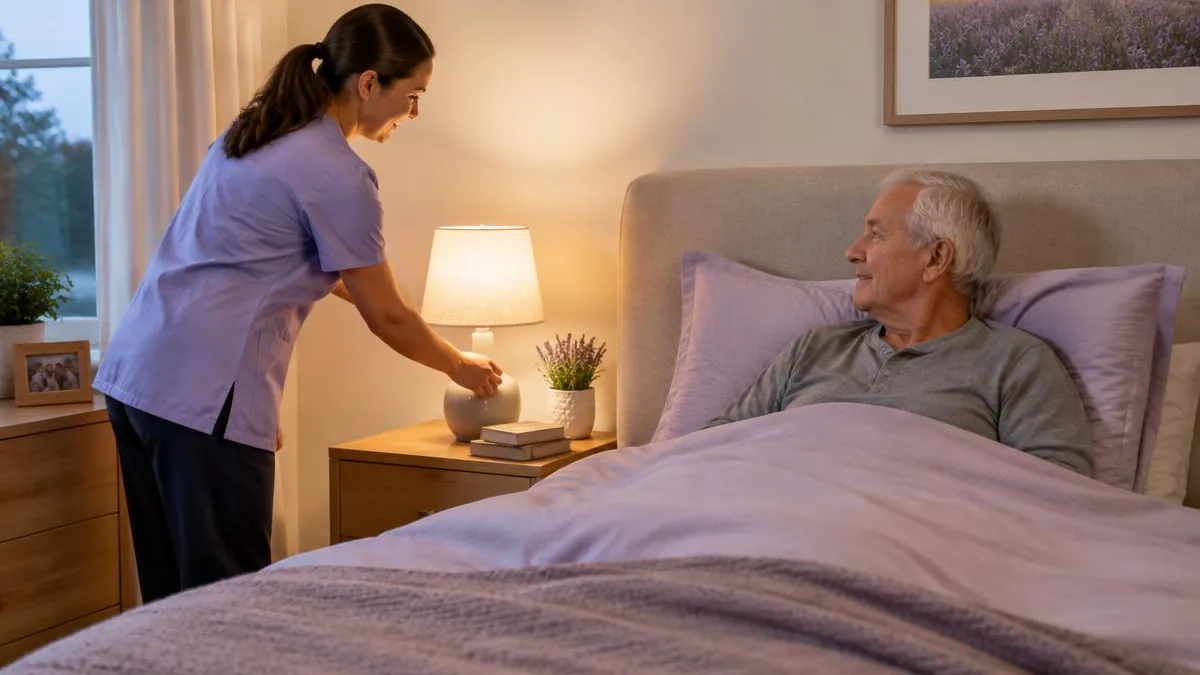
    Caregiver switching on a warm bedside lamp for an older man in bed, a well lit room to ease Parkinson's hallucinations

    Hallucinations in Parkinson's disease, usually visual, often of people or animals, affect a substantial share of people over the course of the disease, sometimes called Parkinson's disease psychosis. Causes include dopaminergic medication effects, disease progression itself, and occasionally an unrelated acute cause like infection (delirium). Minor hallucinations often start years before more vivid episodes. Reporting symptoms early, rather than staying silent, allows treatment options to be considered.

    How Common This Actually Is

    The Parkinson's Foundation notes that what doctors call psychosis in Parkinson's can range from mild perceptual changes to more complex hallucinations and delusions, affecting a substantial share of people with the disease over its course. Despite how common this is, many people experiencing it don't raise it with their doctor on their own.

    Minor vs. Full Hallucinations

    Many people first experience “minor” hallucinations, a sense of presence (someone nearby who isn't there), peripheral movement caught out of the corner of the eye, or brief illusions, years before any more vivid, fully formed hallucination appears. Recognizing these minor symptoms as part of the same spectrum, rather than dismissing them, can help a family and physician track how things are progressing.

    The Three Likely Causes

    Medication effects

    Dopaminergic medications, while essential for managing motor symptoms, can contribute to hallucinations in some people, a genuine trade-off that a neurologist weighs carefully in treatment decisions.

    Disease progression / cognitive decline

    As Parkinson's progresses, hallucinations can become more common as part of the broader disease process, sometimes connected to emerging cognitive changes.

    Delirium (infection, illness, dehydration)

    An acute illness, infection, or dehydration can trigger delirium, which can include hallucinations with a more sudden onset than the gradual pattern typical of disease- or medication-related hallucinations.

    Why So Many Families Don't Report It

    Embarrassment, fear of what the symptom might mean, or simply not realizing it's a recognized and common part of Parkinson's disease all contribute to underreporting. The Parkinson's Foundation specifically encourages open conversation about these symptoms with the care team, since staying silent only delays access to helpful treatment.

    What Helps

    Non-drug approaches

    Ensuring good lighting, reducing clutter and shadows, and calmly acknowledging the person's experience without argument all help reduce distress in the moment.

    Medication review

    Since dopaminergic medications can contribute to hallucinations, a neurologist may consider adjusting the Parkinson's medication regimen as a first step.

    FDA-approved treatment options

    Medications specifically approved for Parkinson's disease psychosis exist and may be appropriate for some people; this is a decision for the treating neurologist based on the individual's full clinical picture.

    When It's an Emergency

    New or worsening hallucinations should always be reported to the treating neurologist promptly, and sudden onset with confusion or illness should be treated as a possible medical emergency (delirium) rather than assumed to be Parkinson's-related.

    What This Means for Care at Home

    Angels on Call Homecare's Care Professionals trained in Parkinson's care are taught to document and communicate changes like new hallucinations clearly to the clinical team, often the detail that helps a neurologist tell these causes apart. Families navigating new hallucinations often feel isolated in the decision of when to call the doctor; an in-home Care Professional trained to recognize these patterns can help catch changes early.

    This article is educational and does not replace medical advice. Always consult the treating physician or care team about symptoms, medications, and changes in condition.

    Sources

    • Parkinson's Foundation, “Hallucinations/Delusions”
    • Parkinson's Foundation, “The Importance of Openly Talking About Hallucinations & Delusions in Parkinson's”

    FAQ Schema Indexed

    Frequently asked questions

    Are hallucinations a normal part of having Parkinson's?+

    They're common enough to be considered a recognized non-motor symptom of the disease, though “normal” doesn't mean they shouldn't be reported, they're always worth discussing with the care team.

    Can stopping a medication make hallucinations go away?+

    Sometimes, if a specific medication is contributing, but this decision must be made by the prescribing physician, since stopping Parkinson's medication abruptly or without guidance can be dangerous.

    Is there a medication specifically approved for Parkinson's-related hallucinations?+

    Yes, there are treatments approved specifically for Parkinson's disease psychosis; a neurologist can evaluate whether one is appropriate for a specific person.

    Why didn't my loved one tell us they were seeing things?+

    Embarrassment and fear are common reasons people stay quiet about this symptom, approaching the topic gently and without alarm can make it easier for someone to open up.

    Do hallucinations mean my loved one is developing Dementia?+

    Not necessarily, though hallucinations can be associated with cognitive changes in some cases, this is a pattern worth discussing directly with the neurologist rather than assuming.

    #parkinsons#hallucinations
    Share
    Eric J. Dalton, Vice President, Angels on Call Homecare

    About the Author

    Eric J. Dalton

    Vice President, Angels on Call Homecare

    CDES · CDCP · Dementia Care Specialist · Montessori Dementia Capable Certification · Teepa Snow Inspired Certification · CPDC · Parkinson's Foundation Site Champion · Aging in Place Essentials Professional

    Dementia and Parkinson's care strategist, systems thinker, and advocate for dignity-centered aging at home. Through Aging in Place Redefined and leadership at Angels on Call Homecare, his work focuses on redefining advanced, emotionally intelligent, clinically guided care at home for families navigating cognitive and neurological conditions.

    Written and reviewed by Eric J. Dalton. Last reviewed Aug 22, 2026. See full credentials
    Specialized Care at Home

    Looking for specialized Dementia or Parkinson's care at home?

    Angels on Call Homecare delivers clinically supervised, specialized in-home care designed around the person, not the schedule of a facility.