In short
Halloween with Parkinson's disease goes best when the evening is planned around the person rather than the other way around. Schedule the main moment for a time when medication usually works well, keep the route to the door clear and bright, let someone else handle the busiest door duty, and agree in advance on a seat, a quiet room and a time to stop. Never change medication timing for a celebration without the prescribing clinician's advice.
Why Halloween can feel different with Parkinson's
An estimated 1.1 million people in the United States are living with Parkinson's disease1, and for many families Halloween is still a highlight: grandchildren in costume, the doorbell, the bowl of candy by the door. Parkinson's affects walking, balance, energy, thinking and how symptoms change through the day, and Halloween compresses several of those challenges into a few busy hours after dark.
Two terms help care partners plan:
- Freezing of gait is a brief, sudden inability to move the feet forward, as if they were stuck to the floor. Walking through a doorway, turning, stepping onto a different surface, stress and multitasking are common triggers2.
- "Off" time describes periods when Parkinson's symptoms return or worsen between medication doses3. Freezing may occur when the next dose is due2.
No two people experience Parkinson's the same way, which is why a personal plan works better than a generic list of restrictions.
Plan the evening around the medication rhythm
Start by asking what part of Halloween the person actually enjoys. Is it greeting grandchildren, handing out candy, watching a favorite film or seeing the neighborhood decorations? Choose one or two priorities instead of trying to do everything.
The Parkinson's Foundation suggests saving outings and bigger tasks for times when medication is working well3. If evenings tend to bring wearing-off, move the main moment earlier: a late-afternoon visit from grandchildren in costume, or the first trick-or-treaters before dusk.
Keep meals, rest and prescribed medication times as consistent as possible; Parkinson's medications are scheduled at particular times to help avoid wearing-off4. Large or high-protein meals can make some medications work more slowly3, so if a Halloween dinner is planned, ask the prescriber how to time it around doses. Do not adjust medication timing or dosage without guidance from the prescribing clinician.
The clock change on Halloween weekend
Daylight saving time ends in early November. In 2026, the clocks fall back at 2 a.m. on Sunday, November 1, the night of Halloween. If doses are taken at set clock times, ask the prescriber or pharmacist before the weekend how to handle the change, and update reminders on every phone, pill organizer alarm or smart speaker the person relies on.
Make the route to the door easy
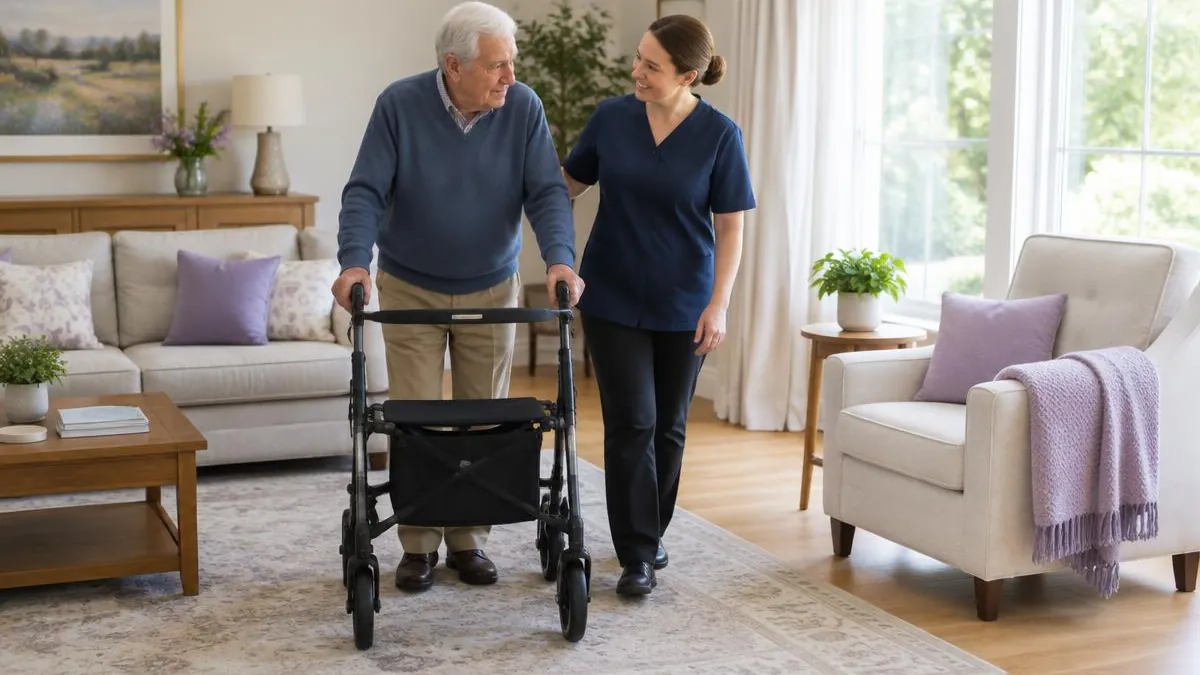
Walk the route from the person's usual chair to the front door before visitors arrive. Remove cords, loose decorations, bags and clutter from walking paths, and keep the porch light on and hallways bright5. Avoid creating narrow paths between decorations, and never place the candy bowl where someone must twist or reach suddenly. If the person uses a walker or cane, leave enough room to use it as intended. For a full room-by-room approach, see our guide to reducing fall risk at home.
Reduce the up-and-down at the front door
The front door is where many holiday plans succeed or stall. A busy doorway asks someone to stand, walk, turn, reach, talk and manage visitors all at once, which is exactly the kind of multitasking that can trigger freezing2. It also means standing up again and again. Some people with Parkinson's experience orthostatic hypotension, a drop in blood pressure on standing that can cause fainting, loss of balance and falls, and Parkinson's medications can contribute to it6.
A simpler setup helps:
- Let a family member answer the door while the person living with Parkinson's stays comfortably seated and joins in when they choose.
- Place a stable chair with armrests in a clear, well-lit spot with a view of the costumes.
- Keep a small candy station at seated height so no one carries a heavy bowl back and forth.
- When the person does stand, encourage them to move slowly from sitting to standing6, and not to walk if they feel dizzy7.
Some families arrange for a Care Professional to be present on busy evenings so the care partner can enjoy the night too.
If freezing happens at the door
Do not rush, push or pull the person forward. Pause, give them time, and use a cue their rehabilitation team has taught them, such as counting, humming a steady rhythm or stepping toward a target on the floor28. If freezing is a recurring concern, a physical or occupational therapist can teach individualized techniques2.
Choose decorations that do not play tricks on the eyes
Many Halloween decorations are designed to fool the eye, and that matters with Parkinson's. Between 20 and 40 percent of people with Parkinson's report hallucinations or delusions, and some experience illusions, misinterpreting real objects in the environment9. Visual hallucinations are more likely in low light9.
Favor steady, even lighting. Keep life-size figures, fog effects and motion-activated props out of the rooms the person uses most. If they become convinced something is real, stay calm and reassuring rather than arguing9. Report any hallucinations or delusions to the medical team, even if they do not seem bothersome9.
Costumes: comfortable, safe and optional
Choose costume pieces that can be put on while seated: a hat, a scarf, a cardigan in a seasonal color or a cape with a simple fastener. Skip masks that narrow vision, long hems and unfamiliar shoes. A costume should be an invitation, never an expectation.
Candy, swallowing and the party plate
Parkinson's can affect swallowing. Coughing or choking before, during or after eating or drinking, or a feeling of food stuck in the throat, are reasons to ask about an evaluation10. If the person has swallowing difficulties, follow the recommendations of their speech-language pathologist and clinical team rather than assuming Halloween treats are appropriate. If swallowing has never been evaluated and you have concerns, the first step is to ask the neurologist about an evaluation by a speech-language pathologist. Offer food only when the person is seated upright4, and make eating and drinking the only focus rather than something done while greeting trick-or-treaters10.
Participation can look different and still matter
This year, participation might mean choosing the grandchildren's costumes, telling a story about Halloween decades ago or handing out the first few pieces of candy before settling in for a favorite movie. Invite participation without turning it into a test of endurance. The tradition is about belonging, not about how long someone can stand at the door.
A five-minute checklist for care partners
- Confirm medication reminders and the plan for the clock change.
- Schedule the main activity for a time that is usually "on."
- Clear the path from chair to door; turn on porch and hallway lights.
- Set up a stable chair with armrests and a candy station at seated height.
- Decide who will answer the door.
- Choose steady lighting over flashing, moving or lifelike decorations.
- Agree on a quiet room and a time to stop.
- Ask the person what they want to do, and let the answer guide the plan.
The takeaway
Halloween does not have to be all or nothing. When families respect the medication rhythm, make movement easier and let the person choose how to take part, Halloween can stay what it has been for decades: a family tradition, adapted with care.
Specialized Parkinson's care at home
Angels on Call Homecare was the first homecare provider in the United States accredited in Certified Parkinson's Disease Care (CPDC™) through PMD Alliance.
Our Care Professionals bring medication-timing awareness, mobility support and an understanding of the non-movement symptoms of Parkinson's disease into everyday routines, including holiday evenings.
Continue the Halloween series
Further reading
This article is for general education and does not replace individualized advice from a physician or other clinician who knows the person. If you notice sudden changes in health, behavior or mobility, contact a healthcare professional promptly.